The piece below is my response to an essay prompt that asked students to evaluate a chosen film’s rotten tomatoes rating.
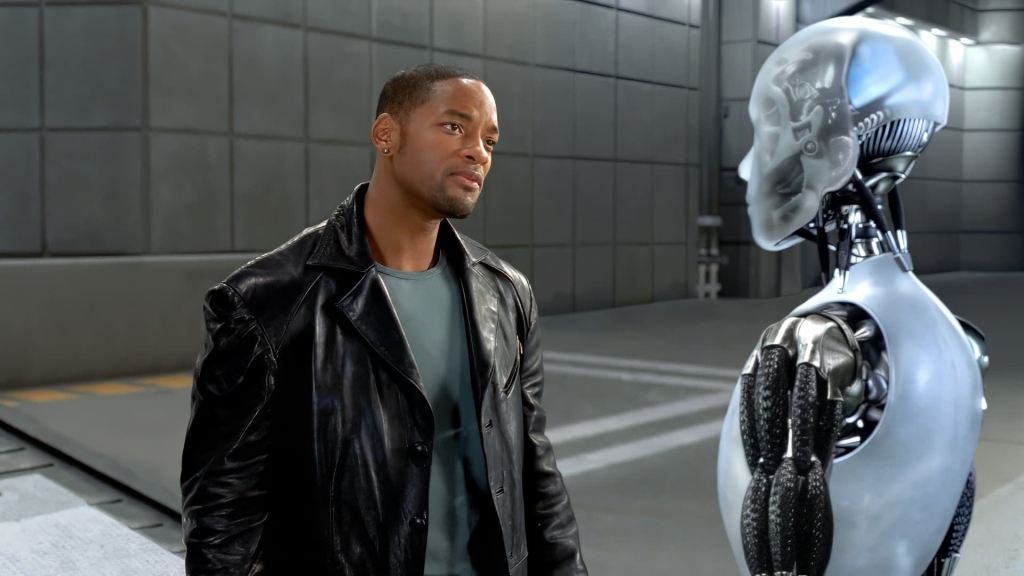
I, Robot deserves worse than its average (56%) rating.
The issues with the movie I, Robot (Alex Proyas, 2004) are numerous but, in their multiplicity, they can be summed up effectively as stemming from cinematic ‘dullness’. It is perhaps not a movie you would expect to be called dull: an action-packed Will Smith film from the early 2000s, it blends elements of science fiction and the detective thriller. It is inspired by an Isaac Asimov novella of the same name. The combination of these elements ought to result in a movie that, if not compelling, is at least engaging for more than half an hour. But I, Robot, I would argue, is not, and the chief reason for this is the movie’s failure to blend its various features together in any way at all, let alone with the imagination required to make it a success. By attempting to be an Asimov mystery, an action blockbuster, and a whodunnit all at once, I, Robot embodies the kind of formulaic, shallow film we have come to associate with Hollywood releases in the years since. It is, in most cases, average in the elements it attempts, combining into a picture of mediocrity well reflected in the film’s Rotten Tomatoes score of 56%. Although I believe that figure to be apt in representing the reasonable attempts made in accommodating elements of action, source material, and character development, and the fleeting enjoyment of the final product, I do not think mediocrity is a harsh enough assessment of the movie. It is a bad film; not offensively bad, because it does not build up the momentum or voice to convey anything of note, but bad on a more fundamental level. It is cinematically dull: pulled apart in opposing directions during production, it was left without vision. In the following essay, I will seek to demonstrate how I, Robot’s critical consensus reflects its defining feature – mediocrity – but also that this mediocrity is more damning than a score of 56% suggests.
To begin, I would like to outline some of the critical mechanisms that will be important to this discussion. To meaningfully evaluate the success or failure of a work of cinema without the help of categorisation is ultimately futile. Noël Carroll has neatly demonstrated the difficulty of compiling a set of objective standards for movies: for him, the essence of film – the ‘cinematic’ – is elusive and actually unhelpful (Carroll, 2003). Carroll argues instead that, to a greater or lesser extent, movies can be categorised into groups based on shared sets of features (2003, p.273.). A horror film, for example, would be expected to contain frightening or disturbing elements, as well as perhaps some inclusion of a supernatural presence. A movie containing these features can reasonably be grouped into the horror category, which gives the film critic a logical basis for evaluating its success. To start, was the film frightening or disturbing? Were these disturbing elements handled in an interesting way, or were they predictable and therefore ineffective? Carroll did not intend to create a schematic for evaluation so much as to argue that meaningful evaluation relies on using the appropriate standards for the category of film in question. This process resists schematisation because, among other reasons, films rarely belong to a single category at once: a romance comedy could reasonably be evaluated along two separate lines – the ability to amuse viewers with its comedy, and to engage them, at least somewhat, in its romance plots.
Examining I, Robot along this strand of thought does it few favours, although its varying elements admittedly appear more effective when analysed apart from each other. To summarise briefly, the narrative takes place in 2035 Chicago in a world where robots are widespread and subservient to humanity. Del Spooner (Will Smith) is a homicide detective who mistrusts robots because of an incident in his past. He is called upon to investigate the apparent suicide of Dr Lanning, the co-founder of U.S. Robotics, whose death Spooner believes to be caused by a rogue automaton. Features of the typical detective story are immediately noticeable: Spooner, owing to his mistrust of technology, is an outsider in his society. His search for the truth takes him from the glittering offices of tech CEOs down to the gritty streets of future Chicago, eventually leading him to uncover a plot that threatens humankind. Along the way, the audience are given circumstantial evidence that suggests the guilt of certain parties only to have it subverted later as the complexity of the case increases. The film nods towards conventions of the murder mystery without trying to achieve the depth of a fully-fledged whodunnit. Spooner is convinced from the start that a robot must be to blame, and he is ultimately proven correct. The only revelation is that it was not the specific robot Spooner believed it to be, but a super powerful artificial intelligence – Viki – who he meets at the start. Worse, it is Viki itself that reveals the plan; the wise-cracking protagonist never needs to scrutinise his findings, confront his biases, or achieve anything at all on an intellectual level because it is proven that he was right all along, and machines are not to be trusted.
The movie fails similarly when analysed as a science fiction thriller. As I will discuss shortly, I Robot was never intended to be an Asimov adaptation. Even so, the film makes such liberties with its namesake that it is almost undoubtable that anybody seeing the film with Asimov’s novel in mind would leave disappointed. The logic underpinning the murder mystery is the three laws of robotics, borrowed from Asimov. The first and most important law states that a robot cannot harm a human or allow a human to come to harm. Viki’s revelation, which is the pivotal moment in the plot, explains that robots are adopting a new, vaguer interpretation of the three laws: since humans are on a path to self-destruction through war and ecological collapse, robots must govern humanity in order to ensure the latter’s long time survival. As such, machines are able to harm a relatively small chunk of the population for the greater good. That this is a tried and tested science fiction trope is not my complaint – I take issue with the way that the movie conveys its twist. Dr Lanner, we are told, was aware of Viki’s sinister plans but unable to act against the machine except to create a suspicious robot – Sonny – (he flees the crime scene and is questioned by Spooner), have Sonny kill him, and hope that Detective Spooner be assigned to the case, even though the two have never met. Moviegoers’ expectations are a significant factor here; that is to say a film that promises science fiction elements so blatantly as one entitled I, Robot is likely to disappoint if it does not deliver its science fiction premise with internal consistency, whether or not it is an Asimov adaptation. Proyas’ I, Robot, to put to it more crudely, is a bit silly. Despite the all-important first law which states that robots cannot harm humans, Del Spooner is being attacked by them constantly. Conveniently, nobody else is present during any of these moments and Spooner’s testimonies are ignored until after the script has had its moment of ‘spectacle’ in a robot uprising.
As mentioned, tumultuous production processes can sometimes be at the heart of a movie’s failure. A disconnect between studios and writers, for example, can lead to an uncoordinated final product, and this is absolutely the case with I, Robot. The original screenplay for the project was written by Jeff Vintar and sold to Walt Disney Pictures in 1995. Vintar’s project was called Hardwired – an Agatha Christie style murder mystery where the suspects are all robots and which, although inspired by Asimov’s short stories, was an original story rather than an adaptation (Topel, 2004). The following years saw the script transformed to accommodate a Hollywood scale production, rewritten by Vintar and subsequently by others who replaced the murder mystery framework with space horror, starring a group of marines sent to destroy a rogue machine (Topel, 2004). After a few years of ‘development hell’, it returned with Vintar in tow (Topel, 2004). While he and director Alex Proyas were creating a new script along the lines of the first, Fox acquired the rights to the Asimov story and requested that Hardwired become I, Robot (Topel, 2004).
Clearly, this laboured production process was not conducive to making a successful Asimov adaptation. The 2004 film is really not an adaptation at all, and this is why it would be disingenuous to suggest that its cinematic mediocrity stems from a departure from ‘source’ material. I mention the production process because it is illustrative of the central flaw of I, Robot: its multiplicity as a film. It is no more a good Asimov adaptation than it is a compelling murder mystery, and the failure in each respect is partly due to the film attempting both simultaneously. Any consistency the project might have had after Jeff Vintar rewrote it as an Asimov thriller was likely blown away after the final twist of the film’s production saga – Will Smith’s late addition. Vintar comments in an interview that one of his original scenes including a few dozen robots was scrutinised during early production for its high cost, but the final version has over a thousand of them rendered in CGI; this he calls the ‘Will Smith effect’ (Topel, 2004). Everywhere one looks, the movie shows its stretch marks caused by its last-minute scale-up from a small budget project to action blockbuster. Even the premise has been warped out of proportion: the original screenplay was condensed around a single murder mystery and the scientific/ethical questions that arise from it (Topel, 2004). In the finished version, however, Del Spooner is saving the world, otherwise, what would be the point in casting Will Smith?
In case you are not convinced, let us examine some of the details of the action. In order to illustrate the destabilising effect of Will Smith’s celebrity status on an already overburdened script, I will attempt a close reading of one of the film’s sequences. After Sonny – the robot involved in Dr Lanning’s death – is captured, it arouses suspicion from Spooner when it suggests to having had a personal relationship with its creator. Despite Spooner’s awakened suspicion, the equally suspect-looking CEO of U.S. Robotics arrives to reprimand Spooner’s department and remove Sonny. The robot, they insist, cannot have free will and is simply malfunctioning. In a classic detective movie trope, Spooner shares a drink with his superior officer in a crummy Chicago bar, the latter telling him to reign in his personal vendetta and forget the case. He also jokes that Spooner, as someone who hates robots, is lucky to be the only person to have been attacked by one because it serves to justify his unusual vendetta. It is this turn of phrase that allows Spooner to realise that his attack was no coincidence, and that Dr Lanning, afraid of his creations, specifically wanted Spooner to investigate. So far, so good: albeit clumsily, the script has successfully utilised Spooner’s mistrust of machines – a key character trait – to logically push forward the plot. He immediately drives to Dr Lanning’s house to look for clues, and the audience, as well as Spooner, begin to hear about the scientists’ uncertainties about the sentience of his robots. I use the word ‘begin’ because shortly after he arrives, a demolition robot unsubtly foreshadowed at the start of the scene bulldozes the house with Spooner still inside, and the movie’s attention turns to action-comedy as the protagonist is forced to escape, begrudgingly saving Dr Lanning’s cat in the process. The suddenness of this attack, which completely undermines the suspense built up during Sonny’s interrogation, illustrates the movie’s constant oscillation between fulfilling its science fiction obligations and being the Will Smith action film that it seemingly would prefer to be. Constantly interspersing one with the other lessens the impact of both because it denies the movie any chance to build up momentum with its pacing.
With my evidence now in place, I want to return to the idea of evaluation on a conceptual level. I do not think that I, Robot’s inconsistency makes it objectively a bad film, as I do not adhere to any critical mechanism that makes objective evaluation possible. As I mentioned in the introduction, while I consider the movie as a whole to be bad, it is comprised of various elements that are fulfilled acceptably, at least according to the tastes of early-2000s reviewers and moviegoers. I would not recommend this film to anybody whose taste I respected, even so it is difficult to deny that I, Robot can be an enjoyable experience on first viewing, including to myself as a youngster. The blockbuster effect melds the film’s disparate elements into a simplified whole which, although it lacks depth, becomes quite a neat little package of cinematic enjoyment. Indeed, it must be conceded that movies have no inherent obligation to intelligent artistic expression, regardless of their well-evidenced potential for it. Pauline Kael’s wittily caustic ‘Trash, Art, and the Movies’ is particularly well suited to this discussion due to the way Kael situates cinematic evaluation into an industrial framework applicable to filmmaking (1969). She comments that ‘whatever the original intention of the writers and director, it is usually supplanted, as the production gets under way, by the intention to make money’ (Kael, 1969, pp. 93-94.). This is intended as a sobering truism rather than a criticism: she also writes that ‘there are much worse things aesthetically than the crude, good natured crumminess, the undisguised reach for a fast buck, of movies without art’ (Kael, 1969, p.93.). One of the ways that her analysis reclaims movie enjoyment from the confines of aesthetic interpretation is by focusing on the enjoyable parts of ‘bad’ movies. This critical approach is refreshing because it reiterates the common-sense notion that what we consider art and what we enjoy consuming are often separate, and this is okay – film need not feel guilty about its pandering to low desires, its self-conscious spectacle, or about its hundreds of poor, substandard releases. I disagree with Kael on her point about the majority of films not being applicable as ‘art’ – the question of what constitutes artistic creation versus what is mere entertainment is an intellectual quagmire without escape. For the sake of simplicity, let us call the whole of cinema ‘art’, but acknowledge, in the spirit of Kael, that film artistry is not the most important aspect of the medium. Movies are complex creations that can be utilised in a variety of ways that do not include artistic interpretation. I, Robot – forgettable, uninteresting, and steeped in mediocrity – is a decent entertainment piece when removed from the sphere of complex film analysis. If most of its viewers are watching it passively, half-awake on the sofa after a hard day’s work, what good is this essay, with all its discussion of industrial processes and internally consistent sci-fi plots?
Does this mean that critical criteria are irrelevant, and that I, Robot, owing to its wide appeal, is actually a good film? I do not think so. In order to partially redeem criticism from the chaos of subjectivity, I want to return to Noël Carroll’s ‘Introducing Film Evaluation’. Carroll’s poignant assessment implies another standard: cohesion. If we take it to be true that films must be evaluated according to standards arising from their categories, and also that a film can be categorised in multiple ways at once, another strand of evaluation arises. As well as analysing a film’s success by the standards of its varying generic elements, we must, of course, consider the whole. As the cinematic canon increases and expands, cinematic products are increasingly defined by their blend of generic elements; by their ability to synthesise. I, Robot’s mise-en-scène is not particularly at fault: the futuristic environments are impressive and, although often bland, are acceptable in creating a convincing backdrop for a gritty sci-fi mystery. Clunky CGI and over-the-top fight sequences can be forgiven, especially in an early 2000s project. In fact, it would be perfectly possible to create a better version of I, Robot that unashamedly indulges in its bashing of robots, cheesy one-liners, and action film tropes, starring Will Smith and with much of the same plot. However, the actual version is too sidelined by its commitments to action blockbuster to be a good sci fi thriller, and vice versa. Hugely successful Will Smith movies from the late nineties serve to reinforce this point. Independence Day (Roland Emmerich, 1996) and Men in Black (Barry Sonnenfeld, 1997) have rotten tomato ratings of 75% and 80% respectively. These films employ a similar framework of the gruff, charming everyman in Will Smith battling against a science-fiction threat, but they do so with a cohesion lacked by I, Robot. In fact, the latter film is like a version of Independence Day in which Will Smith’s character starts off closely investigating the Alien threat, interrogating them one-by-one before getting bored and blowing stuff up instead. It would be difficult to find a clearer example of poor cohesion between a movie’s core components than in the way I, Robot bulldozes through its seemingly intellectual side. In fact, Will Smith as Spooner is anything but intellectual – his blasé attitude, meant to contrast him with the technological sterility of his surroundings, makes him irritatingly detached. This, however, is not the issue. My central point is that none of these flaws objectively condemn the film, mediocre as its elements are, but that I, Robot’s elements do not belong together at all. An obvious lack of cohesion allows one to make a subjective yet logically strong case that I, Robot is a bad film, regardless of whether its mediocrity occasionally makes it fun to watch.
Bibliography
Audio-visual works:
Men in Black [feature film] Dir. Barry Sonnenfeld, U.S.A., 1997. 98 mins.
Independence Day [feature film] Dir. Roland Emmerich, U.S.A., 1996. 145 mins.
I, Robot [feature film] Dir. Alex Proyas, U.S.A., 2004. 115 mins.
Texts Cited:
Carroll, Noël (2003) ‘Chapter 7: Introducing Film Evaluation’, Engaging the Moving Image, pp. 147-164. New Haven, CT: Yale University Press.
Kael, Pauline (1969) ‘Trash, Art, and the Movies’, Going Steady, pp. 87-129. London: Temple Smith Ltd.
Topel, Fred (2004) ‘Jeff Vintar was Hardwired for I, Robot’ in Screenwriter’s Utopia, accessed 01/12/23 < https://www.screenwritersutopia.com/article/d19127d8>
 kaspermcleish.com
Leave a comment