0. Introduction
This report seeks to evaluate the impact, viability, and current status of the proposed Bakerloo Line extension (hereafter: BLE) from Elephant and Castle (hereafter: E&C) to Lewisham, as well as a proposed second phase extension from Lewisham to Hayes/ Beckenham Junction. After exploring the technical details of the extension itself, it will examine the potential economic and social benefits of such a project specifically on the Lewisham area.
These potential benefits will then be compared with the project’s significant costs, allowing an honest appraisal of the extension’s viability within the political climate of the UK following the economic shocks of the last 15-20 years. This section will also examine the strained power dynamics between London – the UK’s economic centre – and the rest of the country, between which the balance of future capital investment remains controversial. In so doing, this report will seek to locate the economic reality of the BLE within the wider context of the UK’s troubled relationship with infrastructure projects.
1. Project Specifications
Although a southern expansion of the Bakerloo line has been considered from as early as the 1930s, with multiple similar proposals since, its current iteration began in 2014 under London mayor Boris Johnson. This proposal seeks to extend the Bakerloo line from its current end-point of E&C station along Old Kent Road towards New Cross Gate and Lewisham.
A further proposed extension would expand the line from Lewisham station towards Beckenham Junction and Hayes via Catford by converting existing National Rail lines into a TFL Bakerloo Line.
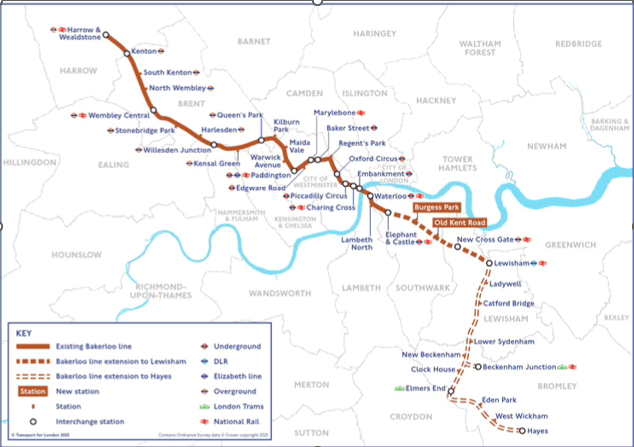
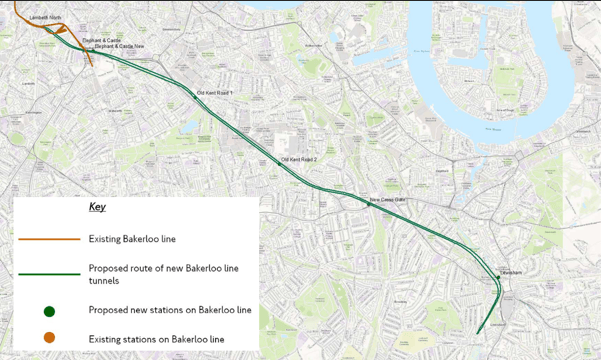
A 2019 background report into a consultation for the project sets out its technical specifications. These proposals will require the current E&C TFL station to be overhauled with a new combined ticket hall for the Bakerloo and Northern lines, as well as a significant tunnelling operation between E&C and Lewisham.
The primary building site for Phase 1 of the extension will be at New Cross Gate, where a new station has been proposed to better connect the Bakerloo Line, Overground services, National Rail, and bus services. This building site will be the foremost entry point for the tunnel-boring machines (TBMs) required for tunnelling operations: an arrangement which would allow most of the spoil created by tunnelling to be transported out of London by train, reducing the environmental impact of the construction process. In between E&C and New Cross Gate, two new Bakerloo Line stations will be built along Old Kent Road.
2. Benefits of the BLE Scheme
London mayor Sadiq Khan’s 10-year plan, published in 2025, reiterates the importance of the BLE as project which could ‘unlock new homes and growth’. It also identifies a selection of ‘strategically important housing-led developments’, among which are key areas serviced by the BLE. One of the largest is Old Kent Road, which is a potential site for 12,500 new homes. New Cross, Lewisham, and Catford could potentially accommodate 13,500 new homes.
Detailed reports into the BLE reveal its potential benefits in greater clarity. A report by Hatch commissioned by Central London Forward estimates that the project will unlock 20,400 new homes, 9700 new jobs, and inject £1.5 billion GVA into the economy.
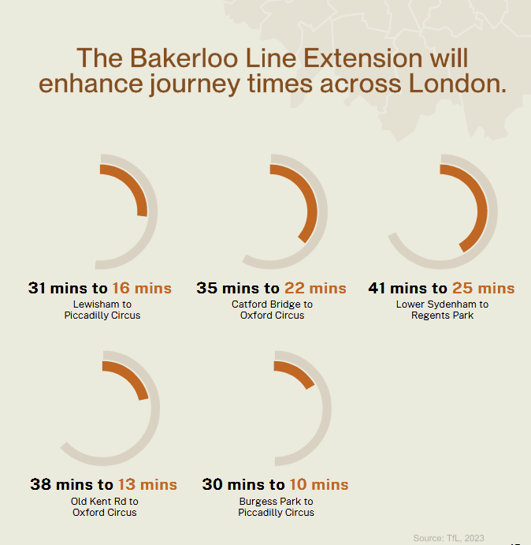
Furthermore, it will make 1.2 million existing jobs along the current Bakerloo line accessible to residents living within 45 minutes commute from Catford. Connecting areas in the southeast to central and north London is likely to have a significant economic impact given that, according to Hatch, almost 1 in 6 of the capital’s jobs are within a 12 minute walk of existing Bakerloo Line stations.
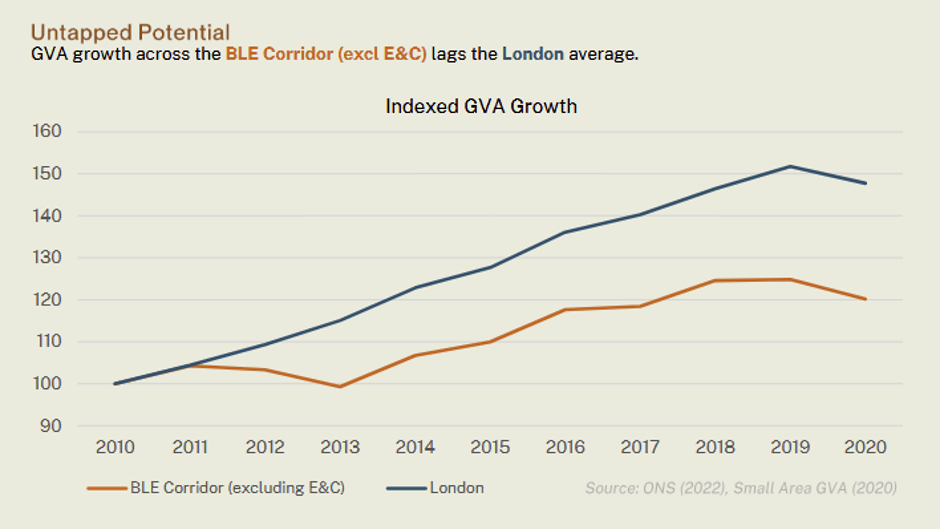
The significant benefits of the BLE described above come as no surprise when considering the economic disparities it looks to address. The level of GVA along the current Bakerloo corridor has depended, to a large extent, on the solid growth around the E&C area but has otherwise been stagnant in recent years. As such, extending the Bakerloo line from E&C – a strong economic hub – to neighbouring areas which are currently underserved by public transport should help to share the area’s economic success with the boroughs of Southwark, Lewisham, and Bromley.
The areas set to be connected to E&C are subject to significant economic disadvantages. The English Index of Multiple Deprivation indicates that the borough of Lewisham is more deprived overall than 84% of Local Authority Areas (LADs). Even more significantly, the borough contains multiple neighbourhoods – known as Lower Layer Super Output Areas (LSOAs) – with acute deprivation.
The neighbourhood surrounding Catford bridge is 99% more deprived than the English average. 3 neighbourhoods around Bellingham are 90% more deprived than the average, with Bell Green’s LSAO 86% more deprived. That these areas are a short distance from the proposed BLE route indicates a strong likelihood of economic rejuvenation arising from the project.
London’s Public Transport Accessibility Level (PTAL) map gives areas a rating between 1a (lowest) and 6b (highest) for accessibility. Lewisham as a whole receives a rating of 3, average for London. A zoomed-in view of the borough reveals notable gaps in public transport connectivity, where multiple areas north of New Cross receive a rating of 1b-2.
Unfortunately, these are likely to be missed out by the extension along Old Kent Road. However, Bell Green also has a significant 1b-rated section that is likely to benefit from BLE Phase 2 connections, including a new station in Lower Sydenham. Overall, the BLE would likely improve the overall accessibility of public transport in the area, helping bridge the gap between Lewisham and central London boroughs with ratings in the 5-6b range.
Finally, the construction of the project itself promises to boost the UK economy. Two firms have been selected for the BLE’s delivery: Aecom and WW+P, the latter of which is responsible for the Elizabeth line stations at Old Street and Paddington and is based in the UK. In addition, the rolling stock for both the BLU and BLE will be built at Yorkshire-based Siemens Mobility, thus creating growth outside the capital as well as inside.
3. Current Status of the BLE
The most recent public 2019 consultation for the project indicated ‘overwhelming support’ for the BLE, with 89% of respondents supporting the scheme. This is accompanied by the Back the Bakerloo campaign – jointly run between Lewisham and Southwark councils – which has continued to push enthusiastically for the project since its inception.
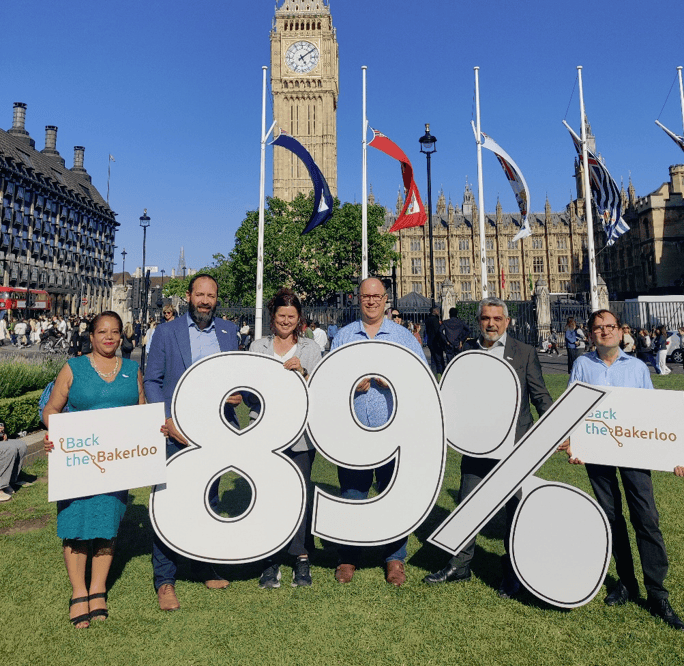
Despite this, the extension’s future remains uncertain. According to TfL, the project is in the planning and funding phase, with a 2022 estimate putting the cost of Phase 1 between £5.2 billion and £8.7 billion, though inflation has undoubtedly caused this figure to rise. The initial Statutory Safeguarding of the required land has been secured, however. TFL remains committed to the project in the future, hoping to begin construction on Phase 1 in the early 2030s.
The delivery of London’s Elizabeth Line helps to clarify the likely funding arrangements for the BLE. Also known as Crossrail, this immense project was funded by a combination of central government grants and the Greater London Authority, where the latter drew on private investment including increased business rates levies in areas that would benefit from the new line. Using a similar funding model for the BLE would require an extra levy on London businesses which are already paying increased rates until 2035 to pay for Crossrail.
TfL is an unusual entity in the landscape of UK transport infrastructure. Publicly owned and operated, it has the luxury of reinvesting any profit made into maintenance and renewal, and its income, driven largely by fares, is sufficient to cover all of its operating costs. However, TfL does not have the funds to cover its own capital investment projects, requiring central government grants to do so. A report into TfL’s finances show that the organisation used to receive both a revenue grant and a capital grant from central government but it currently receives only the latter. In return, it is allowed to make use of a large proportion of the GLA’s retained business rates, but, overall, this still means that TfL must contribute more of its revenue towards capital expenditure than previously.
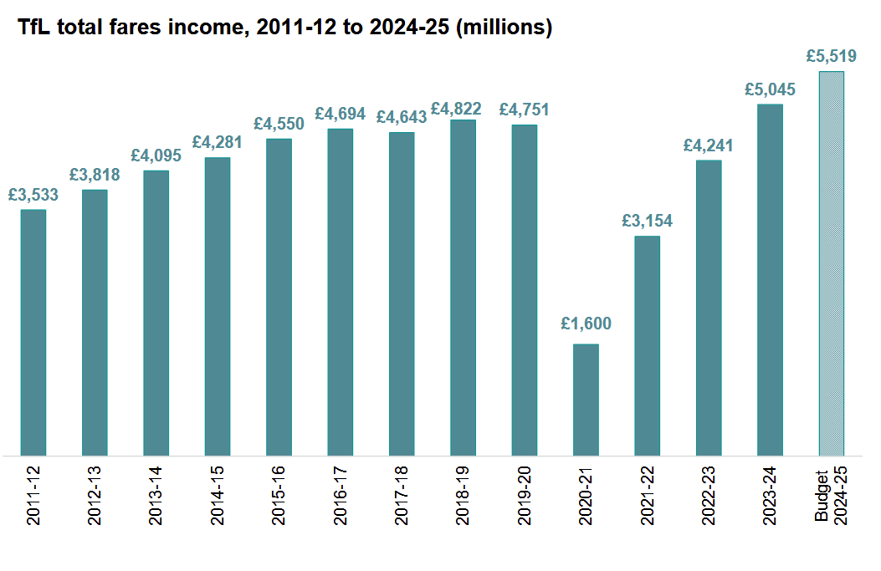
Worse still, TfL was left reeling after the sharp drop in fare income during the pandemic, requiring large bailouts from central government to continue operating.
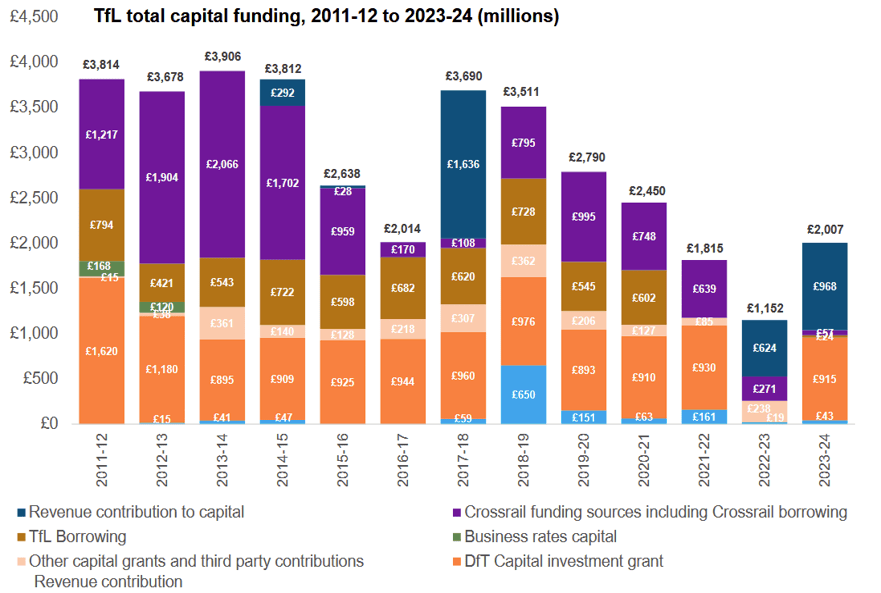
| Figure VI: TfL Capital Funding. Source: London Assembly |
| Figure VII: TfL Fare Income. Source: London Assembly |
These developments have had a radical impact on the body’s capital spending capabilities, where the proportion of capital spending in overall expenditure has fallen from 38% to 8% between 2011 and 2024. In return for the £2.2 billion that TfL received in the June 2025 spending review, Sadiq Khan is under order to increase fares until 2030, meaning that Londoners are already paying increased fees for recent government intervention that TfL needs for critical maintenance and renewal.
In the aftermath of both the costly Crossrail scheme and the disruptions of the pandemic, central government is limited in how much funding they can set aside for TfL capital investment. The Autumn 2025 budget saw chancellor Rachel Reeves greenlight both the DLR extension to Thamesmead and the Lower Thames Crossing, but no mention was made of the BLE.
4. Wider Context: Infrastructure in a low-growth economy
The UK’s financial current landscape explains, in part, its troubled relationship with capital expenditure. The 2008 financial crisis has led to a stagnation in construction sector productivity, which, when combined with inflationary post-pandemic shocks and increased energy costs following the Russia-Ukraine war, have made UK infrastructure remarkably expensive to deliver.
Much has been made of what some perceive as the nation’s overly-bureaucratic planning processes. Controversies around HS2, including apparent Nimbyism and stringent environmental regulation, have exposed core weaknesses in the UK’s approach to capital projects. Successive governments have also been slow to update National Policy Statements (NSPs – regulatory guidance on how to interpret planning legislation), leaving developers to spend millions, or even billions, in consulting and planning fees to cover every possible legal eventuality.
As well as finally providing an updated NSP, the current Labour administration has sought to remedy this sclerotic planning situation through the creation of a new body – Nista – although its focus remains on the largest ‘Nationally Significant Infrastructure Projects’ (NSIPs), leaving little room for developments such as the BLE.
Finally, the UK’s political environment has created real challenges for increasing capital expenditure. Chancellor Rachel Reeves’ commitment to restrictive fiscal rules combined with the administration’s manifesto pledge not to increase income tax reflects the administration’s approach to fiscal management, where Labour seeks to grow the economy in order to facilitate future investment, not the other way around. In other words, a joint commitment to keep income tax down and reduce the deficit presents serious problems for projects like the BLE. The government’s strategy of attracting private investment might alleviate this problem but such a dynamic relies on having sufficient business confidence for investment, and worldwide economic pressures along with stagnant domestic growth make this difficult.
There is a core debate at the heart of this situation. London remains the UK’s economic powerhouse and its GVA is, to a greater or lesser extent, redirected to other parts of the country to provide much-needed investment. Sadiq Khan’s 10-year plan states: ‘much of the infrastructure investment London needs could be funded by letting London retain and reinvest more of the upside of the growth it creates’. While this is undoubtedly the case, such an approach risks seeing the nation’s finances in precisely the London-centric manner that, some argue, has left other regions (particularly struggling areas in England) without the public investment needed to become economic hubs in their own right. As such, the BLE may be an obvious and vital project for Londoners, but the controversial balance of economic power between the capital and the rest of the country reveals an ongoing dilemma of which the BLE is only one part.

